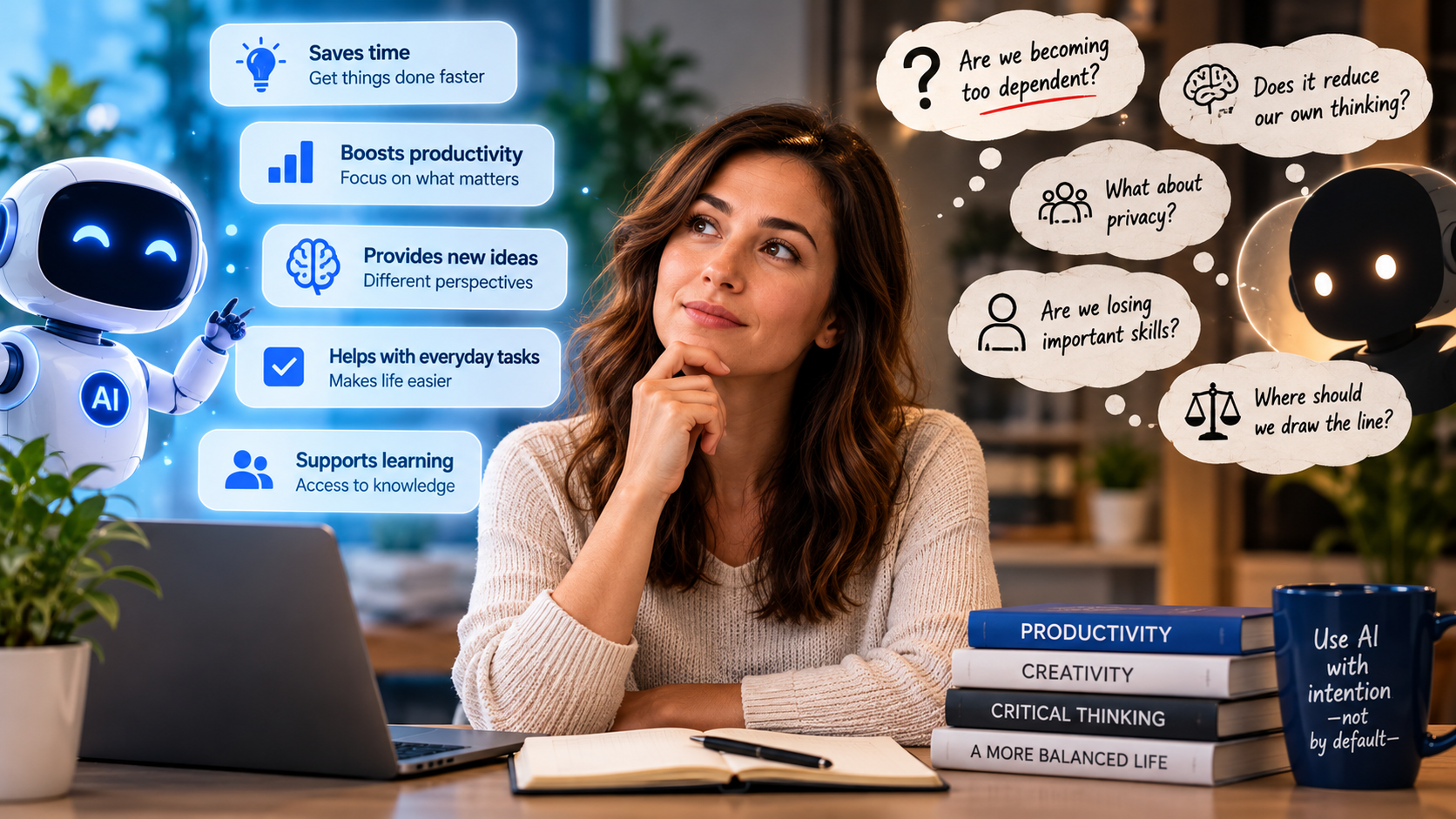
Is AI Making Our Lives Easier — or Are We Becoming Too Dependent on It?
Think about how many times you've interacted with artificial intelligence today.
Perhaps you asked it to write an email.
Maybe it summarized something you didn't have time to read.
It might have suggested what to cook, helped you understand a complicated subject, translated a message, generated an image, analyzed some data or answered a question that would previously have required several searches.
Increasingly, we don't even notice when AI is involved.
And that raises an interesting question:
At what point does a useful tool become something we depend on too much?
There Is No Question That AI Can Be Useful
The benefits are difficult to ignore.
AI can complete certain repetitive tasks in seconds.
It can help us explore ideas, organize information, understand unfamiliar subjects and reduce the time spent on routine work.
For a small business, that might mean doing work that previously required additional employees or external services.
For a student, it might mean having a learning assistant available at any hour.
For an ordinary person, it could simply mean getting help planning a trip, understanding a document or writing a difficult email.
Used well, AI can give us something extremely valuable:
time.
But What Do We Do With the Time We Save?
This may be one of the more interesting questions surrounding AI.
Imagine that AI saves you five hours every week.
That's potentially more than 250 hours over a year.
What happens to those hours?
Do we spend them creating something?
Learning?
Talking to people?
Growing a business?
Spending time with family?
Or do we simply fill the newly available time with even more tasks?
Technology has been promising to save us time for decades.
Yet many people don't feel that they have more free time than previous generations.
Perhaps productivity and quality of life aren't always the same thing.
What Happens When AI Starts Thinking Before We Do?
There's another, more subtle question.
Suppose every time we encounter a problem, our first reaction becomes:
“I'll ask AI.”
At first, that seems perfectly reasonable.
Why spend twenty minutes solving something if a tool can help in twenty seconds?
But some of the value of solving problems comes from the process itself.
We research.
We make mistakes.
We compare possibilities.
We change our minds.
We develop judgment.
If AI increasingly performs that process for us, could we eventually become very good at obtaining answers while becoming less comfortable finding answers ourselves?
Consider Something as Simple as Writing
AI can produce an email almost instantly.
That's useful.
But writing isn't simply the mechanical process of arranging words.
Writing forces us to decide what we actually think.
Sometimes you don't fully understand your own position until you try to explain it to somebody else.
If AI always performs that step first, there's a risk that we begin selecting from its thoughts instead of developing our own.
That doesn't mean we shouldn't use AI for writing.
It means we should perhaps ask:
Is AI helping me express what I think, or deciding what I think?
The Same Question Applies to Creativity
AI can generate images, music, designs, videos, ideas and stories.
For people who couldn't previously create these things, that can be incredibly empowering.
Someone with an idea but limited technical ability can suddenly turn that idea into something visible.
That's a genuine expansion of creative capability.
But creativity also develops through limitations.
Struggling with an idea can lead somewhere unexpected.
Learning a craft changes the way we see the world.
Failure teaches us what works and what doesn't.
If creation becomes as simple as describing what we want, will we become more creative because more people can create?
Or less creative because fewer people learn the underlying craft?
Perhaps both can be true at the same time.
There Is Also the Question of Trust
AI can sound extremely confident.
Confidence, however, is not the same thing as correctness.
An answer can be beautifully written, logically structured and completely wrong.
This creates a new responsibility for the person using the technology.
When should we verify the answer?
When should we question it?
When is AI appropriate for generating possibilities but inappropriate for making the final decision?
The better AI becomes, the more important these questions may become, because incorrect answers may become increasingly difficult to recognize.
Maybe the Question Isn't Whether We Should Use AI
That debate may already be outdated.
AI is becoming part of software, search engines, phones, workplaces, customer service systems and everyday applications.
For many people, choosing to completely avoid AI may eventually become as impractical as choosing not to use the internet.
Perhaps the more useful question is:
Which parts of our lives should we willingly delegate to AI, and which parts should we deliberately keep for ourselves?
Not Every Task Has the Same Value
There is a big difference between asking AI to reorganize a spreadsheet and asking AI to make an important life decision.
There is a difference between automating repetitive administration and outsourcing your judgment.
There is a difference between using AI to explore possibilities and accepting the first answer it produces.
Perhaps we need to stop thinking about AI usage as simply:
Use AI / Don't use AI.
Instead, we might think about three categories.
1. Tasks We Can Comfortably Delegate
Repetitive work, organization, formatting, basic information processing and other tasks where automation mainly saves time.
2. Tasks Where AI Should Assist Us
Research, brainstorming, analysis and creative work where AI can provide ideas or perspectives, but a person should evaluate the result.
3. Decisions We Should Keep Human
Situations involving personal values, important judgment, relationships, responsibility or consequences that shouldn't simply be delegated to an algorithm.
The Most Valuable Skill May Be Knowing When Not to Use AI
As AI becomes easier to access, using it won't necessarily be the difficult part.
Almost everyone will be able to ask an AI a question.
The more valuable skill may become knowing:
- When to use it
- What to ask
- When to question the answer
- When to verify the information
- When to make the decision yourself
- And when not to use AI at all
In other words, perhaps the future isn't about becoming dependent on AI.
It's about becoming good at working with it.
AI Should Give Us More Control, Not Less
This is also an idea we think about while developing technology at BizPlifier.
Automation is most useful when it removes repetitive work while leaving important decisions and boundaries under human control.
But that principle extends far beyond business software.
AI should ideally expand what people are capable of doing.
It shouldn't quietly reduce what they're capable of doing without it.
So Where Should We Draw the Line?
Imagine AI becomes significantly better over the next few years.
It writes better.
It researches faster.
It plans better.
It remembers more.
It handles more of our everyday tasks.
At what point would you deliberately choose not to use it?
Would you still write something yourself simply because thinking through the words matters?
Would you solve a problem yourself because you want to maintain the skill?
Would you make certain decisions without asking AI because they should remain entirely yours?
Or, if AI consistently produced better results, would refusing its help eventually become irrational?
There may not be one correct answer.
But it's probably a question worth asking now, while we still consciously notice when we're choosing to use AI.
AI can save us time, expand our capabilities and help us solve problems. The challenge may be making sure that, while gaining those abilities, we don't unnecessarily give away our own.
What do you think?
Should AI become an everyday companion that we rely on whenever it can help — or should we deliberately keep it as a tool that we only reach for when we really need it?