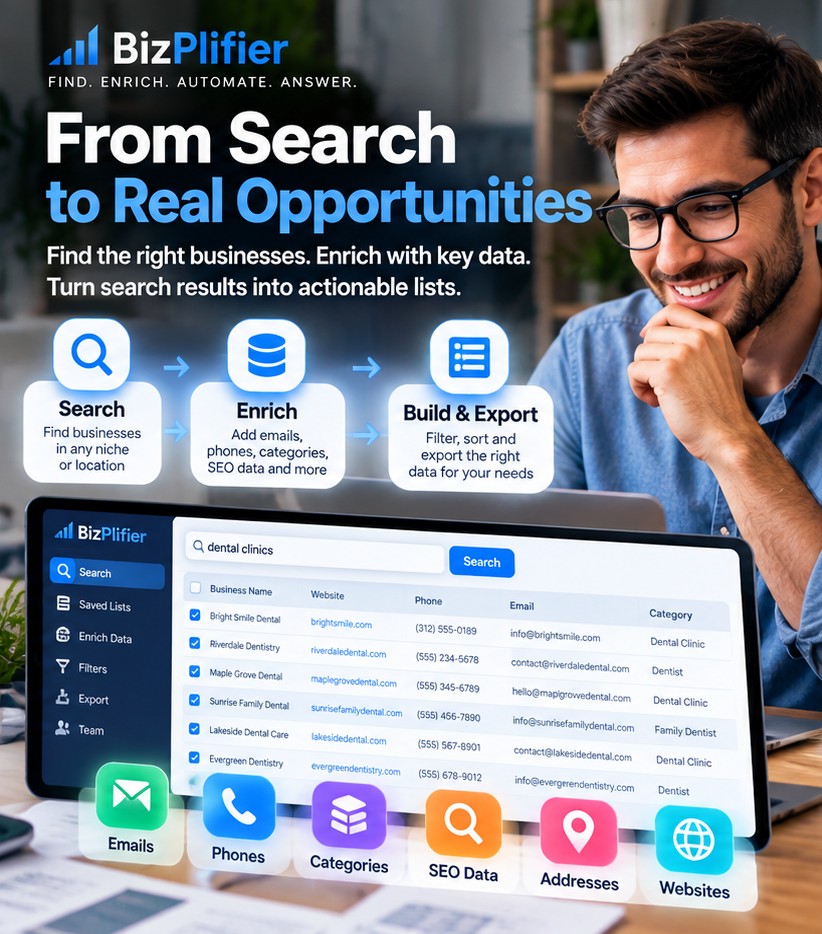
From Search to Real Opportunities: Is Finding Businesses Enough?
Finding a business on the internet has never been easier.
Type a few words into a search engine and within seconds you can have dozens, hundreds or even thousands of potential results.
But here's a question that doesn't get asked nearly as often:
What do you actually do with those results?
Because finding a company and having useful business intelligence about that company are two very different things.
The Search Result Is Only the Beginning
Imagine you're looking for dental clinics, construction companies, photographers, marketing agencies or almost any other type of business.
A search might give you:
- A business name
- A website
- A short description
- A location
That's useful.
But if you're trying to research a market, build a prospect list, identify potential partners or prepare an outreach campaign, it's probably not enough.
The questions begin almost immediately.
What's their website?
How can I contact them?
What category does the company belong to?
Where are they located?
What can I learn about their online presence?
Which of these businesses actually match what I'm looking for?
That's Where Research Usually Becomes Manual Work
For many businesses, the next step involves opening tabs.
Lots of tabs.
Visit the company website.
Look for the contact page.
Find an email address.
Look for a phone number.
Copy the information into a spreadsheet.
Go back to the search results.
Open the next company.
Repeat.
Finding the businesses may have taken five minutes.
Turning those businesses into useful data can take hours.
What If Search Was the Start of a Workflow?
Instead of treating search as the final result, what if it was simply the first step?
The workflow could become:
Search → Save → Enrich → Filter → Sort → Build → Export
Now the objective isn't simply to find websites.
It's to progressively transform search results into a useful business dataset.
Enrichment Changes the Value of a Search Result
A company name and URL tell you that a business exists.
Additional information can help you understand whether that business actually matters to your objective.
Depending on the available data and research being performed, enrichment can add information such as:
- Business email addresses
- Phone numbers
- Business categories
- Website information
- Addresses and locations
- Contact information
- Website and SEO-related data
- Other useful business intelligence
Suddenly you're no longer looking at a collection of search results.
You're building a dataset.
But More Data Isn't Always Better
This creates another problem.
Once you enrich hundreds or thousands of businesses, you may have considerably more information than you actually need.
So the next question becomes:
How do you identify the right data inside all that data?
That's where filtering and sorting become just as important as discovery.
Perhaps you're only interested in businesses from a particular location.
Or businesses from a particular category.
Or records where certain contact information is available.
The useful dataset may only be a small portion of the original search.
The Goal Isn't the Biggest List
It's tempting to measure business research by quantity.
“We found 10,000 businesses.”
That sounds impressive.
But what if only 300 of those businesses actually match your objective?
A smaller, relevant and properly structured dataset can be considerably more useful than a huge collection of loosely related results.
The goal shouldn't be to collect the most data. It should be to find the right data.
This Is the Workflow We're Building Into BizPlifier
BizPlifier is designed to connect business discovery with what happens after the search.
Instead of treating search results as the end of the process, users can save businesses into lists and continue working with that information.
Data can then be enriched using available BizPlifier tools, organized, filtered and sorted according to the objective of the research.
The resulting dataset can then be prepared for the next stage of the user's workflow and exported when needed.
The idea is simple:
Search shouldn't leave you with another pile of links to research manually.
When Does a Search Result Become an Opportunity?
Maybe it's when you discover the company.
Maybe it's when you find the right contact information.
Maybe it's when you understand enough about the business to know that it's relevant.
Or maybe it's only when all of that information becomes structured enough to actually do something with it.
That's an important distinction.
Because businesses don't really need more search results.
They need information they can act on.
Here's the Question
Think about the last time you researched potential customers, suppliers, partners or competitors.
How much time did you spend actually finding them?
And how much time did you spend opening websites, copying information, cleaning spreadsheets and trying to decide which results mattered?
If you could automate one part of that process tomorrow, which part would save you the most time?
BizPlifier
Find. Enrich. Automate. Answer.
Turn business discovery into organized, enriched and actionable data.