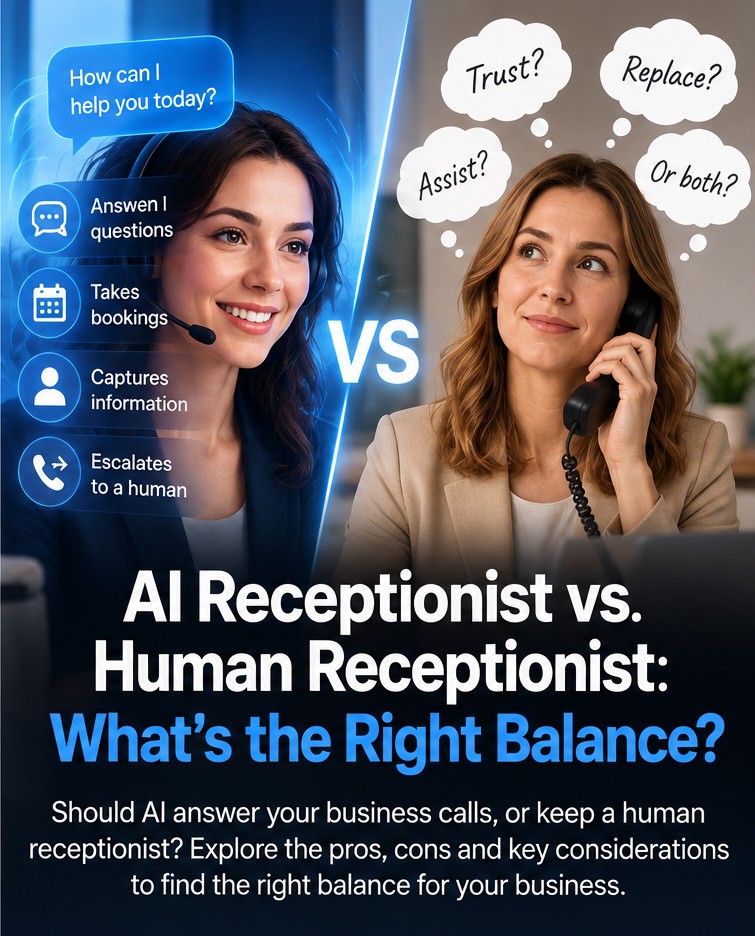
AI Receptionist vs. Human Receptionist: What's the Right Balance?
Here's a question we're going to hear increasingly often:
Should businesses replace human receptionists with AI?
It's an attention-grabbing question.
It might also be the wrong one.
Because the future of business communication may not be a choice between humans and AI at all.
It may be about deciding which conversations each should handle.
There Are Things Humans Are Extremely Good At
Imagine an angry customer calling with an unusual problem.
Or someone trying to explain a complicated situation that doesn't fit neatly into any predefined process.
A good receptionist can listen, understand context, notice emotion, improvise and make judgment calls.
Humans can also recognize something difficult to define in software:
“This situation is unusual. I need to handle it differently.”
That's enormously valuable.
But Humans Have Limitations Too
A human receptionist can only handle so much.
People need breaks. They finish work for the day. They take holidays. They get sick. They can already be speaking to another customer when the next call arrives.
And many small businesses don't have a dedicated receptionist at all.
The “receptionist” might actually be the business owner answering the phone between appointments.
That's where AI becomes interesting.
AI Has a Very Different Set of Strengths
AI doesn't need to replace everything a receptionist does to be useful.
Consider the predictable part of incoming calls:
- “What time do you close?”
- “Do you provide this service?”
- “Can I make an appointment?”
- “Can somebody call me back?”
- “I'd like to leave a message for someone.”
- “I need to change my booking.”
These interactions don't necessarily require complicated human judgment.
An appropriately configured AI assistant can potentially handle the first stage of these conversations while collecting the information the business needs.
So Why Not Automate Everything?
Because capability isn't the same thing as responsibility.
The fact that AI can respond doesn't necessarily mean it should be allowed to make every decision.
Businesses need boundaries.
What happens when the AI doesn't know the answer?
What happens when a customer asks for something unusual?
What happens when a conversation becomes sensitive?
What happens when the caller is angry?
A trustworthy AI system shouldn't simply keep talking because it can.
Sometimes the correct response is:
“A human needs to handle this.”
The Most Important AI Feature Might Be Knowing When to Stop
We often evaluate AI by asking how much it can do.
Maybe we should also evaluate it by asking how reliably it recognizes what it shouldn't do.
Imagine two AI assistants.
The first tries to answer absolutely everything.
The second confidently handles routine interactions but escalates whenever the conversation exceeds its responsibilities.
Which would you trust with your customers?
For many businesses, the second may ultimately be more valuable.
What If AI Worked With Your Team Instead?
Instead of:
AI vs. Human
perhaps the better model is:
AI + Human.
AI could answer when employees are unavailable.
It could handle repetitive questions.
It could collect information before transferring a call.
It could take messages outside business hours.
It could capture booking requests while the team is busy.
Then humans could spend more of their time on conversations requiring judgment, expertise, empathy or decision-making.
Would That Actually Be Better for Employees?
There's another side to this conversation that receives less attention.
If AI handles repetitive interactions, what happens to the human role?
Does the business eliminate that role?
Or does the person simply have more time for valuable work?
Imagine a receptionist who no longer has to interrupt an important customer interaction to answer:
“What time do you close today?”
Is that replacing the receptionist?
Or is it giving that employee a better tool?
There Probably Isn't One Correct Answer
A dental practice, plumbing company, law office, restaurant and real estate agency don't have identical customer conversations.
The appropriate balance between automation and human involvement will therefore be different for every business.
That's why AI call handling shouldn't necessarily be an all-or-nothing decision.
Businesses should be able to define:
- What the AI is allowed to answer
- What information it should collect
- What actions it can perform
- Which conversations require human involvement
- When and why a call should be escalated
That's How We're Approaching It at BizPlifier
The BizPlifier AI Receptionist is designed around configurable call handling rather than the assumption that AI should control every conversation.
The goal isn't simply to make an AI voice sound human.
It's to create a useful division of responsibilities between automation and people.
AI handles the predictable. Humans handle the exceptions.
Where Would You Draw the Line?
Imagine an AI assistant answering your business phone tomorrow.
You control exactly what it's allowed to do.
What would you trust it with?
Answering basic questions?
Collecting contact details?
Taking messages?
Booking appointments?
Transferring calls?
And at what point would you say:
“No. A person needs to handle this.”
That boundary may ultimately be more important than the technology itself.
BizPlifier
Find. Enrich. Automate. Answer.